
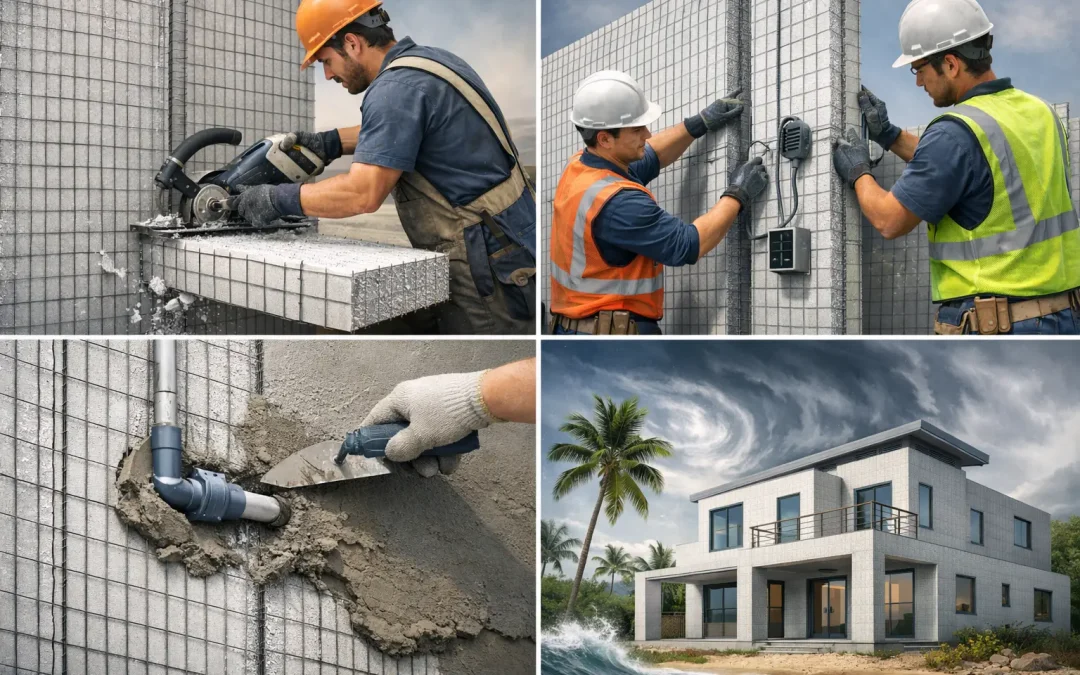
When a coastal project loses its envelope, the damage rarely stops at the walls. Wind-driven rain enters, interior finishes fail, MEP systems become exposed, and recovery costs climb fast. That is why SCIP hurricane-resistant wall panels are gaining serious attention from developers, builders, and design teams working in the Southeast, Gulf Coast, Caribbean, and other high-wind regions.
The real question is not whether stronger wall systems matter. It is whether the panel system you specify can deliver structural performance, code compliance, installation efficiency, and long-term value in one integrated solution. For many projects, especially where owners are rethinking wood framing after recent disasters, SCIP construction deserves a close look.
What hurricane-resistant wall panels need to do
The structure to be hurricane resistant has to perform as part of a complete structural system under high wind pressures, impact exposure, and water intrusion risks. In practical terms, that means the wall needs to resist lateral loads, maintain integrity when the storm envelope is stressed, and connect effectively to the roof, floor, and foundation.
This is where many conventional assemblies start showing trade-offs. Wood framing can be familiar and widely available, but in severe wind zones it often requires layers of additional detailing, hardware, sheathing strategy, and labor oversight to reach the needed level of performance. Masonry can offer strength, but it may slow schedules, add weight, and increase labor demands depending on the market. Not every project can absorb those costs or delays.
SCIP panels approach the problem differently. A typical panel uses a core of EPS insulation between welded galvanized steel wire mesh, then receives structural concrete mortar on both sides to create a monolithic assembly. Once installed and properly finished, the wall acts as a reinforced structural element rather than a collection of separate parts trying to work together under storm loads.
Why SCIP panels are being specified in storm-prone markets
The appeal is not just strength. It is the combination of strength, speed, and thermal performance in one system.
For contractors, labor efficiency matters almost as much as engineering performance. High-wind construction often becomes expensive because crews are asked to coordinate multiple layers of framing, insulation, bracing, and weather protection under tight schedules. A panelized system reduces that complexity. Teams can set panels, tie reinforcement, and apply mortar with a more streamlined installation sequence than many traditional wall assemblies.
For developers and owners, the long-term economics are just as important. Hurricanes are destructive events, but operating expenses are a year-round issue. A wall system with continuous insulation helps reduce heat gain in hot climates, which can lower HVAC demand and improve occupant comfort. This becomes a stronger selling point in regions where both insurance and energy costs continue to rise.
For architects and engineers, the key issue is whether the system can be documented and detailed in a way that supports permitting, structural review, and project execution. That is why code alignment and technical evaluation matter. A disaster-resistant product without a clear compliance path creates friction. A system designed around tested performance and engineering documentation is much easier to bring into real projects.
How hurricane-resistant wall panels compare to wood framing
Wood framing remains common because the industry knows it well. It has a mature labor base, familiar detailing, and broad supply availability. But familiarity is not the same as suitability.
In hurricane-prone zones, wood-frame buildings depend heavily on connectors, sheathing attachment, moisture management, and field quality control. If one part of that chain is weak, storm performance can suffer. That does not mean wood cannot be designed for high winds. It can. The issue is how much effort, material, and inspection it takes to get there and how the building performs over time when exposed to repeated moisture and extreme weather cycles.
SCIP wall systems shift more of the performance burden into the assembly itself. The finished panel provides structural continuity, impact resistance, and insulation in a single buildable component. That can reduce the number of failure points compared with layered assemblies that rely on many separate products and trades. It also gives project teams a path away from combustible framing in markets where recent fire events have renewed focus on resilience.
The trade-off is that SCIP is not a drop-in substitute for stick framing. It requires trained installation, proper mortar application, and coordination with structural engineering and project sequencing. Teams that treat it like a conventional nonstructural panel will miss the value. Teams that understand it as a complete building system usually see the benefit much more clearly.
Performance is about the whole assembly, not the panel alone
One of the biggest mistakes in storm-resilient design is evaluating walls in isolation. Even the best hurricane-resistant wall panels can underperform if they are poorly connected to the slab, ring beam, roof structure, or openings.
Openings deserve special attention. Windows and doors often become weak points during hurricanes, especially under pressure cycling and impact events. The wall system must be detailed to transfer loads around openings and maintain structural integrity when the envelope is stressed. That includes reinforcement strategy, fastening schedules, and coordination with rated fenestration systems.
Roof-to-wall continuity also matters. If the roof system is vulnerable, wall strength alone will not save the building. The same applies at the foundation interface. A true high-performance structure depends on a continuous load path from the roof to the footing.
This is one reason complete system providers have an advantage. When panels, accessories, equipment, and installation methodology are treated as one integrated approach, the project is less likely to suffer from fragmented responsibility.
What builders should look for before specifying a system
If you are evaluating SCIP or any other high-wind wall assembly, start with the engineering path. Ask whether the system has testing, technical reports, and design support that align with U.S. code requirements. If the answer is vague, expect delays later.
Next, look at constructability. A strong wall system that slows the field crew or requires highly specialized labor may still make sense on some projects, but not all. Installation speed, crew training, material handling, and equipment needs all affect the real cost.
Then evaluate climate performance beyond the storm event. In hot, humid regions, insulation value and thermal continuity matter every day. A wall that performs during a hurricane but drives up cooling loads the rest of the year is only solving part of the problem.
Finally, consider the insurance and durability conversation. Owners are paying closer attention to lifecycle risk than they did a decade ago. After major disasters in the U.S. and Latin America, including severe seismic events in Venezuela, resilience is no longer a niche selling point. It is becoming part of the basic underwriting and ownership equation.
Where SCIP fits best
SCIP is especially well suited for residential communities, mid-rise multifamily, hospitality, schools, commercial buildings, and industrial facilities in high-risk wind zones. It is a strong fit where the project team wants structural strength, insulation, and labor efficiency without relying on combustible wall framing.
It can also be a smart option for developers standardizing a repeatable building system across multiple sites. Repetition improves installation efficiency and makes crew training more valuable over time. That is harder to achieve when every project depends on a different combination of framing, insulation, and structural upgrades.
Not every project will choose SCIP. Some teams are deeply invested in conventional methods, and some markets still price labor in ways that favor traditional construction. But as labor costs increase, energy performance standards tighten, and resilience becomes a bigger factor in financing and insurance, the case for monolithic insulated structural systems gets stronger.
Structural Panels GCT supports that shift directly by offering not just SCIP panels but also equipment, technical education, and system-level support. For professionals trying to move from interest to execution, that matters.
The bigger shift behind hurricane-resistant wall panels
The market is moving beyond the old question of cheapest first cost. Builders and owners are asking a tougher question now: what system still makes sense after the storm, after the inspection, after the insurance review, and after years of energy bills?
That is why hurricane-resistant wall panels are not just a niche product category. They represent a broader change in how resilient buildings are being designed and delivered. In storm-prone regions, the better choice is often the system that combines structural performance, insulation, speed, and code-ready documentation in one assembly.
If you are designing for the next decade rather than the next bid cycle, that is a hard question to ignore.