
A school addition, cash room, government office, or distribution facility does not get to treat wall selection as a cosmetic choice. When occupant safety, forced-entry delay, and liability exposure are on the line, the wall assembly becomes a performance decision. That is where a bullet resistant wall system moves from a specialty upgrade to a serious part of the design conversation.
For many project teams, the first instinct is to think in terms of steel plate, masonry, or aftermarket ballistic panels added to conventional framing. The problem is that patchwork assemblies often solve one risk while creating others. Weight goes up, installation slows down, thermal performance suffers, and field coordination becomes harder than it should be. A better approach is to look at the wall as a complete structural assembly from the start.
What a bullet resistant wall system really needs to do
A true bullet resistant wall system is not just a hard surface that can stop a round under limited conditions. It needs to perform as an integrated assembly with predictable structural behavior, repeatable installation, and support for the broader demands of the building. That includes load resistance, insulation, finish compatibility, durability, and code alignment.
This matters because ballistic protection is rarely the only design driver. In high-risk zones, owners are often dealing with multiple hazards at once. Recent events, from the LA Palisades fires to seismic damage in Venezuela, have pushed more developers, architects, and builders to question whether conventional wood framing is still the right baseline for critical structures. If a wall system can contribute to ballistic resistance while also improving fire performance, wind resistance, and structural resilience, it becomes far more valuable than a one-purpose add-on.
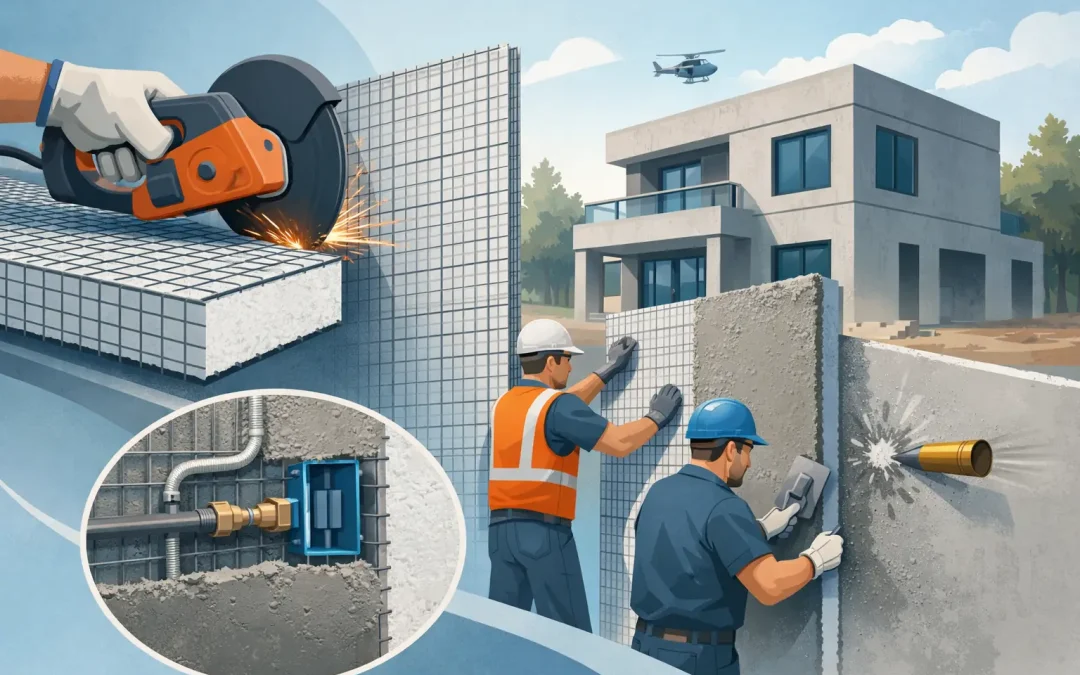
That is why assemblies built with SCIP deserve attention. A panel made with galvanized steel wire mesh, an EPS insulating core, and high-strength concrete mortar is doing more than replacing studs. It is creating a monolithic wall with mass, continuity, and structural integrity that conventional framed walls struggle to match.
Why SCIP panels are being considered for bullet resistant walls
SCIP construction changes the conversation because it starts with a different wall logic. Instead of a cavity wall that depends on layers of separate materials attached to a light frame, SCIP panels become a reinforced concrete shell around an insulated core. Once properly shotcreted or mortar-applied, the panel acts as a hardened assembly rather than a collection of components.
That has direct relevance for ballistic performance. Mass matters. Concrete matters. Reinforcement matters. Continuity matters. A wall that distributes impact through a cementitious skin reinforced by steel mesh performs differently from gypsum over studs or thin cladding over light-gauge members.
The practical value is just as important. Many owners looking for a bullet resistant wall system are also trying to shorten schedules, reduce skilled labor dependence, and control long-term operating costs. SCIP panels address those concerns at the same time. The EPS core supports energy efficiency. Panelized installation can accelerate dry-in. The finished assembly can reduce the number of separate trades and materials required compared with layered conventional systems.
For a contractor or developer, that means the security conversation does not have to be isolated from the economics conversation. The wall can be designed for strength and efficiency together.
Bullet resistant wall system performance depends on the full assembly
This is where disciplined specification matters. Not every wall marketed for security performs the same way, and not every ballistic requirement calls for the same solution. The level of threat, the projectile type, the required rating, and whether spall control is needed will change the assembly design.
With SCIP, performance depends on factors such as mortar or shotcrete thickness, reinforcement configuration, panel geometry, openings, connection details, and how the wall ties into floors and roofs. Doors, frames, glazing, and penetrations also matter. A wall may have strong ballistic resistance in the field area but become vulnerable at joints or utility openings if those details are not handled correctly.
That is why sophisticated buyers do not ask only, “Can this wall stop a bullet?” They ask whether the entire envelope and structural package support the project’s threat profile. They ask what test data exists, what engineering assumptions are being used, and how the assembly aligns with the building’s other demands.
In real projects, the answer is often not a universal wall type used everywhere. It may be a selective strategy. Public-facing counters, secure rooms, perimeter sections, equipment enclosures, and sensitive storage areas may require higher protection than surrounding spaces. A system that can be engineered and detailed across those conditions has a real advantage.
How SCIP compares with wood framing and conventional alternatives
Wood framing remains common because the industry knows it, crews can source it easily, and first-cost expectations are familiar. But familiar does not always mean suitable. For projects facing fire exposure, severe weather, seismic concerns, or elevated security requirements, wood-frame assemblies often require so many add-ons that the baseline cost logic starts to break down.
A framed wall upgraded for ballistic resistance can involve specialty panels, extra backing, additional fastening, separate insulation layers, and more coordination around finishing. That can create an assembly that is slower to install and less integrated than expected.
Concrete masonry can offer mass and durability, but it brings its own trade-offs. It is labor-intensive, slower to erect, and can require more field effort to deliver the same combination of structure and insulation. If the project team is trying to improve speed while maintaining a hardened building envelope, SCIP can be a more efficient path.
This is the core advantage of a well-designed SCIP-based bullet resistant wall system. It consolidates structural performance, thermal performance, and hardening potential into one buildable assembly. That does not mean it is the right answer for every project. Highly specialized facilities may still require dedicated ballistic panels, armor plate, or hybrid systems in specific areas. But for many residential, institutional, commercial, and industrial applications in higher-risk regions, SCIP offers a more balanced performance package than conventional framed construction.
Where this approach makes the most sense
The strongest use cases are buildings where security risk overlaps with environmental risk and operating cost pressure. Schools, clinics, municipal buildings, border-area facilities, emergency response structures, multifamily developments in storm zones, and selected industrial buildings all fit that profile.
These are projects where a single-purpose product is usually not enough. Owners want a wall that supports safety, insurability, energy performance, and long-term durability. They also want predictable installation and fewer surprises in the field. That is why interest in hardened panelized systems continues to grow, especially after high-visibility disasters expose the weaknesses of lighter conventional assemblies.
In hot climates and hurricane-prone regions, the value becomes even clearer. If the same wall that contributes to ballistic resistance also supports thermal control and wind resilience, the lifecycle argument gets stronger. Security does not need to come at the expense of efficiency.
What specifiers and builders should verify before choosing a system
A bullet resistant wall system should never be selected from a brochure headline alone. Engineers, architects, and contractors need to verify test data, structural calculations, code pathway, and installation requirements. They should evaluate how the wall interfaces with foundations, slabs, roof diaphragms, openings, and MEP penetrations.
Field execution matters just as much as design intent. A strong system can be compromised by poor mortar application, weak attachment details, or uncoordinated penetrations. This is one reason complete-system providers have an advantage over sellers of isolated components. When panels, application equipment, installation methods, and technical support are aligned, the project team has a better chance of achieving the performance that was specified.
For buyers comparing alternatives, it is worth asking a blunt question: does this wall only solve one problem, or does it help solve five? In many cases, SCIP earns consideration because it addresses structural strength, speed, insulation, resilience, and security in one coordinated assembly. Structural Panels GCT is part of that conversation because the system is positioned not as a niche material, but as a practical replacement for outdated framing assumptions in demanding environments.
The smartest wall choice is rarely the one with the loudest claim. It is the one that performs under pressure, installs predictably, and keeps working long after the project is turned over.