
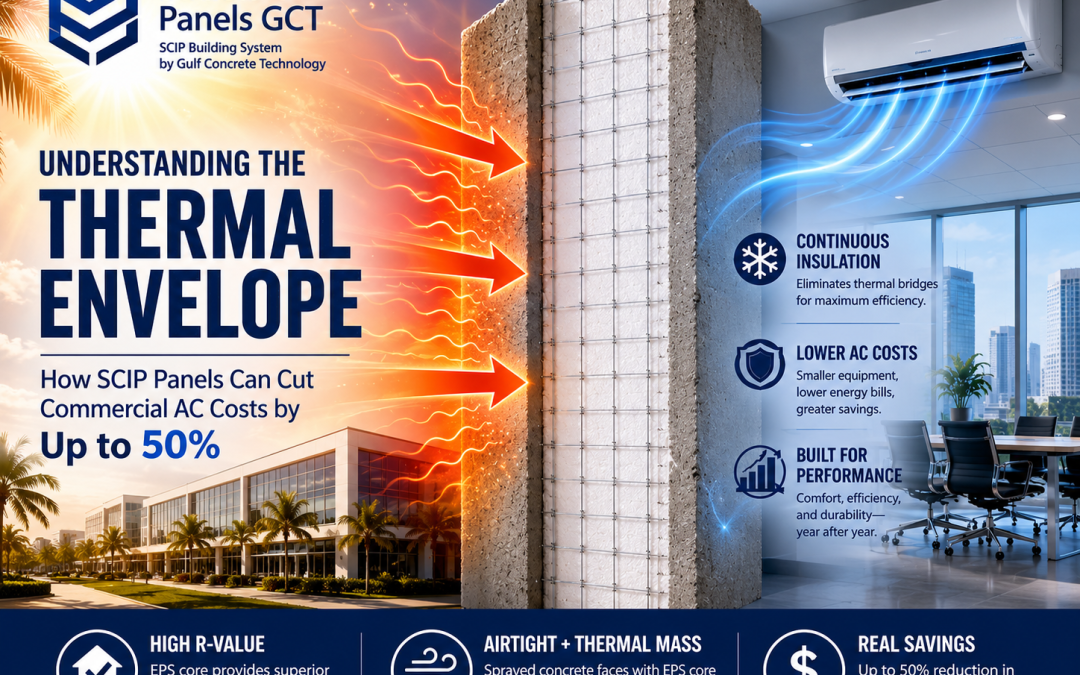
In tropical climates, coastal areas, and hot southern states, air conditioning is not a luxury — it is one of the biggest ongoing expenses a commercial building or home will ever face. Unfortunately, most standard construction methods, such as wood framing and concrete block (CMU), share a common problem that makes cooling costs much higher than they need to be because of the thermal bridging.
What Is a Thermal Bridge?
A thermal bridge is any spot in a wall where heat can travel easily from the outside to the inside of a building. Think of it like a gap in a winter coat, no matter how warm the rest of the coat is, heat will escape right through that gap.
In a concrete block wall, every mortar joint, grout-filled cell, and structural column acts as one of these heat pathways. Concrete conducts heat well, so when the sun beats down on an exterior wall, that heat moves straight through the solid material into your air-conditioned interior. The result: your AC runs constantly, your electricity bills are high, and your equipment wears out faster.
The SCIP Solution: Continuous Insulation
GCT’s Structural Concrete Insulated Panels (SCIP) solve this problem by using a design principle called Continuous Insulation (CI).
Every SCIP panel is built around a solid core of one of the best insulations, the Expanded Polystyrene (EPS). It is the same rigid foam material used in high-performance insulation products that runs uninterrupted from one end of the wall to the other, top to bottom. Because there are no studs, ties, or solid concrete paths cutting through the insulation, there are no virtually thermal bridges. Heat simply has no path to travel through the wall.
Here is what that means in practice:
- High R-Value: The continuous EPS core provides high thermal resistance (R-value), a measure of how well a material resists heat flow that exceeds what most building codes require.
- Airtight Assembly with Thermal Mass: The EPS core is sandwiched between two layers of structurally sprayed applied concrete. This combination creates an airtight wall with high thermal mass, meaning the outer concrete shell absorbs the heat from the sun during the day, while the EPS layer prevents that heat from ever reaching the interior. The inside of the building stays at a stable, comfortable temperature, and your AC doesn’t have to work nearly as hard.
The Financial Benefits: Savings Start Before You Pay the First Utility Bill
Because a SCIP building envelope is so effective at blocking heat, the savings begin at the design stage:
- Smaller HVAC Equipment: A mechanical engineer designing a SCIP building can specify smaller air conditioning units, chillers, and duct systems than a standard building would require. Smaller equipment means lower purchase and installation costs from day one.
- Lower Maintenance and Longer Equipment Life: When indoor temperatures stay stable, your AC system doesn’t cycle on and off as frequently. Less cycle means less wear and tear, which translates to lower maintenance costs and fewer equipment replacements over the life of the building.
- Reduced Monthly Energy Bills: With less heat entering the building, cooling systems run less often and less intensely, producing real, measurable reductions in electricity consumption every month.
Investing in a high-performance thermal envelope is one of the smartest decisions a builder or property owner can make, especially in hot climates where cooling costs never go away. GCT’s SCIP system turns every wall into an efficient thermal barrier, delivering permanent cost savings from the day the building opens. Request a Quote or write us via WhatsApp at: 228-343-2475.