
For decades, concrete masonry units (CMU)—commonly known as concrete cinder blocks—have been the default structural element across coastal regions and the Caribbean. It is a familiar, predictable method. However, in today’s volatile market, predictability does not guarantee profitability. Rising labor shortages, stricter post-hurricane building codes, and skyrocketing insurance premiums are squeezing developer margins tighter than ever.
To stay competitive, forward-thinking developers are looking beyond the raw material cost of a single block and evaluating total structural lifecycle costs. This is where Structural Concrete Insulated Panels (SCIP) are fundamentally shifting the landscape. Let’s break down the head-to-head financial realities of CMU versus SCIP construction.
The True Cost of CMU: The Invisible Line Items
At first glance on a line-item estimate, a standard concrete block appears inexpensive. But a block wall does not build itself, insulate itself, or finish itself. To achieve a structurally sound, code-compliant coastal building envelope using CMU, a developer must account for multiple sequential, labor-intensive steps:
- Laying the blocks manually.
- Installing temporary wood support shuttering, placing vertical reinforcement and grouting the cells feeding heavy rebar steel down the cells, and pouring concrete grout cores.
- Applying separate interior and exterior insulation systems to meet energy codes.
- Applying multi-coat plaster and stucco finishes over a rough, uneven surface.
Each separate phase introduces a new subcontracting crew, logistical coordination risks, material waste, and extended timeline dependencies. If a single trade is delayed, the entire project stalls, driving up carrying costs and construction loan interest.
The SCIP Advantage: Consolidating the Trades
The GCT SCIP Building System replaces this fragmented, multi-step process with a single engineered component. A SCIP panel consists of a continuous, high-density Expanded Polystyrene (EPS) insulation core sandwiched between two layers of high-strength, 3D galvanized steel wire mesh.
Instead of managing four different trades to build a single wall, the SCIP system consolidates structural framing, insulation, and the substrate for finishing into one rapid installation phase.
- Weight Efficiency: Because the SCIPs raw panels are incredibly lightweight, a small crew can manually lift, position, and tie an entire story together without the costly rental of heavy cranes or specialized rigging.
- Monolithic Strength: Once the panels are anchored, a high-strength concrete shell (shotcrete) is mechanically pneumatically sprayed onto both sides. The result is a monolithic, continuous structural sandwich wall that exhibits zero cold joints, eliminating reducing the common moisture penetration points inherent to standard mortar seams in CMU block.
- Financial Head-to-Head: Labor, Time, and Structural Margins
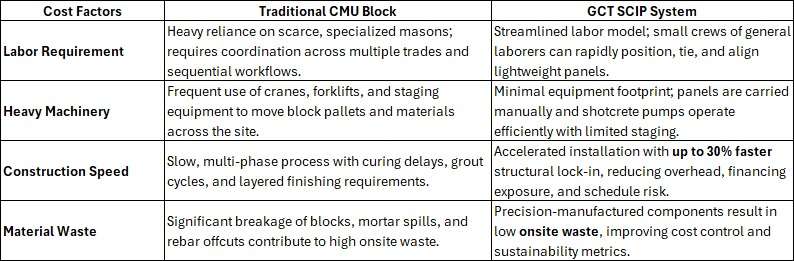
When evaluating the total cost of ownership and execution, the structural savings of SCIP become clear:
Conclusion & Action Step
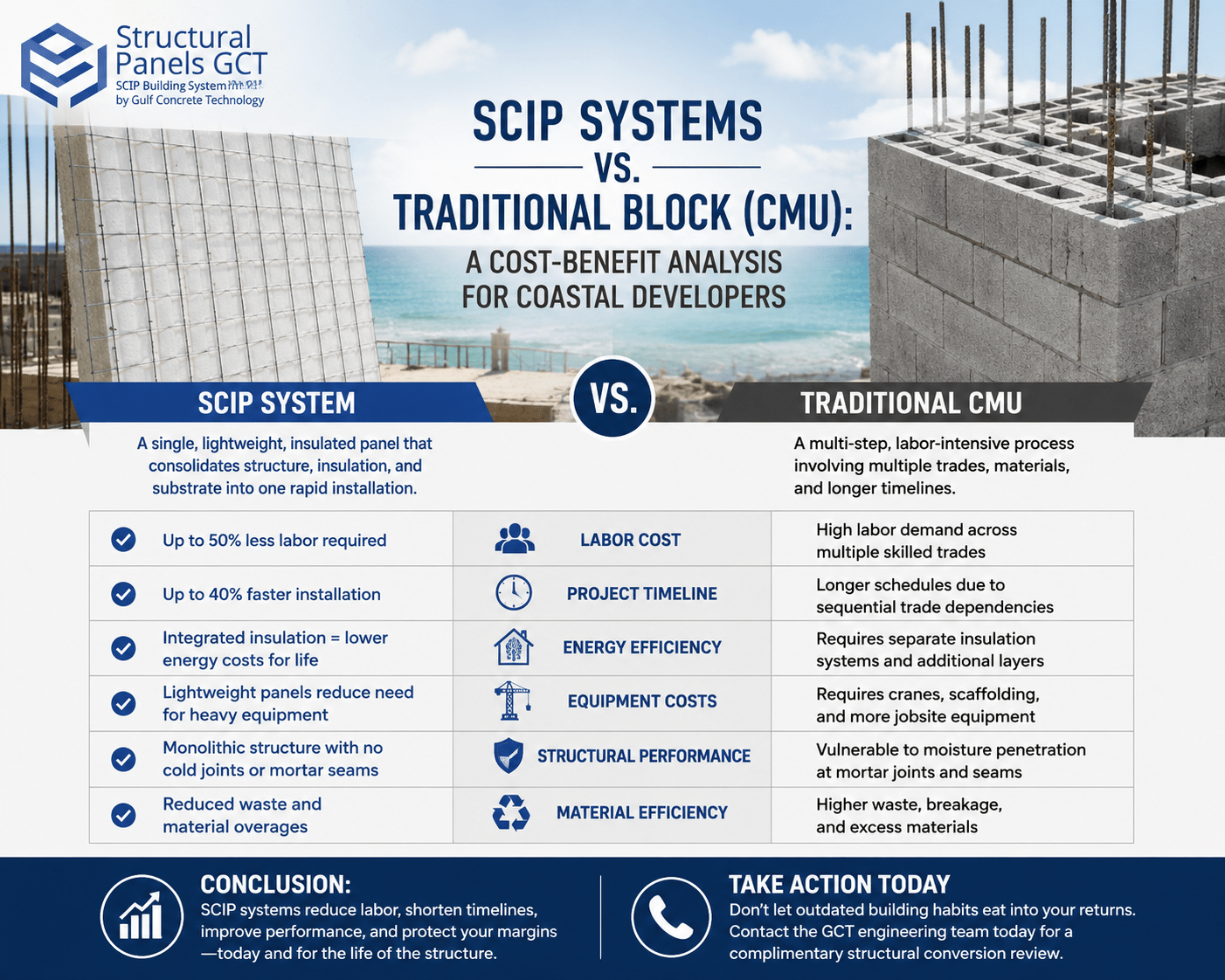
While traditional concrete blocks may present a lower initial material cost on paper, it forces developers to absorb high labor costs, lengthy project schedules, and systemic inefficiencies. By consolidating structural integrity and continuous insulation into a single lightweight panel, the GCT SCIP system protects your timeline, reduces your exposure to labor shortages, and ultimately maximizes your developer margins.
Contact Us
Don’t let outdated building habits eat into your project returns. Write us at our WhatsApp at 228-343-2475 or click here to request a quote and submit your blueprints for a complimentary structural conversion review and see exactly how much you can save on your next project