
When labor is tight, schedules are slipping, and insurers are scrutinizing material choices after the LA Palisades fires, fast install building panels stop being a convenience and start becoming a serious project strategy. For builders, developers, engineers, and architects working in fire, hurricane, or seismic zones, the question is no longer just how fast a wall goes up. The real question is whether the system can go up quickly without giving back performance in code compliance, durability, or long-term operating cost.
That is where SCIP construction stands apart. Structural Concrete Insulated Panels are not a cosmetic prefab shortcut. They are a structural system built around galvanized steel wire mesh, an EPS insulating core, and concrete mortar applied to create a high-strength assembly. In practical terms, that means one panel system can address structure, insulation, and installation efficiency at the same time.
What makes fast install building panels different
Speed in construction often comes with a trade-off. Some systems install quickly because they shift complexity to later phases. Others reduce site labor but create coordination problems with structure, MEP routing, or finishes. Fast install building panels only make sense when they compress the schedule without creating downstream friction.
SCIP panels do that by consolidating functions that are usually separated in conventional wood or masonry construction. Instead of framing walls, then adding insulation, then managing multiple layers and trades, the panel arrives as a ready structural and thermal base. Once erected, tied, braced, and finished with mortar, it becomes a durable building assembly with fewer moving parts than many conventional wall systems.
That matters on projects where labor cost is rising faster than material cost. A system that reduces framing hours, shortens enclosure time, and simplifies sequencing can change the economics of the build. It can also reduce exposure to weather delays, which is a major issue on coastal and storm-prone jobs.
Why SCIP panels move faster on site
The speed advantage is not just about panel size. It comes from reducing repetitive field work. Traditional wood framing requires cutting, fastening, sheathing, insulating, and then addressing fire and moisture detailing across multiple assemblies. Masonry brings durability, but it can be slower, wetter, and more labor-intensive depending on crew availability and site conditions.
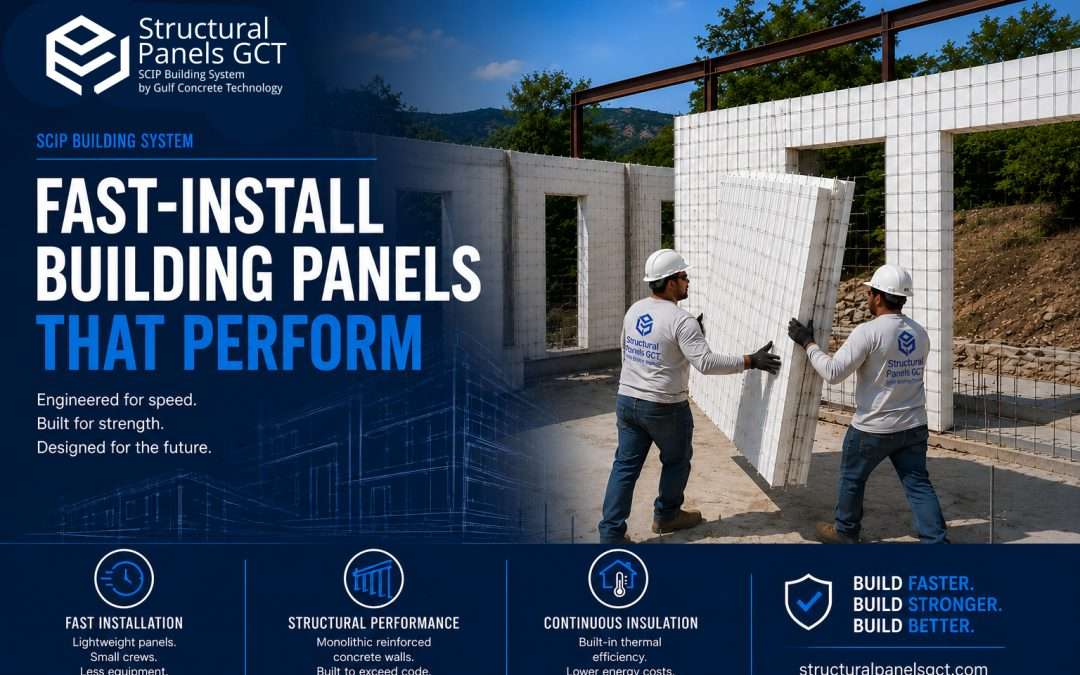
SCIP panels streamline that process. Crews place the panels, connect them according to engineering requirements, install reinforcement where needed, and apply mortar using the appropriate mixing and spray equipment. With trained installers and a coordinated plan, this can significantly reduce the time from slab to enclosed structure.
For contractors, the labor profile is a major reason these systems get attention. You are not depending on a large framing crew in a market where experienced labor is expensive and inconsistent. You are also reducing the number of separate trades needed to create a structural insulated envelope.
That said, fast does not mean careless. SCIP systems reward planning. Layout accuracy, bracing, connection detailing, openings, and mortar application all need to be managed correctly. The projects that move fastest are usually the ones that treat the system as an engineered process, not as a panel substitute dropped into a conventional workflow.
Fast installation matters more in high-risk regions
In lower-risk markets, speed is usually discussed in terms of carrying cost and delivery deadlines. In high-risk regions, speed also affects exposure. The longer a project remains partially complete, the more vulnerable it is to weather events, material damage, and schedule disruption.
That is one reason alternative systems are gaining attention after recent disasters. The Palisades fires pushed many project teams to reexamine the weakness of combustible assemblies in fire-prone areas. In seismic regions, the failure of brittle or poorly detailed systems remains a major concern. In hurricane zones across the Caribbean and the southern United States, wind resistance and envelope integrity are constant priorities.
Fast install building panels are only valuable in those environments if they also deliver resilience. SCIP panels are designed for exactly that conversation. When properly engineered and installed, they provide strong resistance to fire, wind, and seismic forces while also improving thermal performance. That makes them relevant not just for speed-focused projects, but for risk-conscious ones.
Comparing SCIP to wood framing and masonry
Wood framing still dominates many residential and light commercial projects because crews know it, supply chains are established, and first-cost assumptions are familiar. But familiarity is not the same as best-fit performance. In wildfire-prone areas, wood introduces an obvious combustible element into the structure. In hurricane and seismic zones, detailing becomes critical, and long-term durability can depend heavily on moisture management and workmanship quality.
Masonry offers strength and noncombustibility, but it can be slower to build and more dependent on skilled labor that is not always easy to source. It may also require additional insulation strategies to hit energy performance targets.
SCIP sits in a useful middle position. It offers a nontraditional installation method with strong structural and thermal advantages, while helping teams reduce labor intensity and build faster. The trade-off is that it requires system-specific knowledge. Contractors, engineers, and architects need to understand panel layout, structural behavior, openings, reinforcement, and finishing methods. For serious project teams, that is not a drawback. It is simply part of adopting a higher-performing system.
Where fast install building panels deliver the best ROI
Not every project benefits equally from panelized construction. The strongest fit is usually where time pressure, resilience requirements, and operating cost all matter at once. That includes housing in hurricane corridors, multifamily and hospitality work in hot climates, commercial projects facing labor shortages, and institutional buildings where durability and life-cycle cost are under review.
Insurance pressure is also changing the ROI calculation. Developers and owners are increasingly looking beyond initial build cost and asking what the building will cost to insure, maintain, and protect over time. A system that installs faster but also offers stronger resistance to fire, wind, and earthquakes can look very different when viewed through that lens.
This is especially true for projects in jurisdictions where code alignment and technical documentation matter. Engineers and specifiers need more than a marketing claim. They need a system with tested performance, clear installation protocols, and a path to compliance. That is where a complete SCIP provider has an advantage over a generic panel supplier.
Installation speed depends on system support
One mistake buyers make is evaluating panel systems only by product dimensions or unit price. In the field, installation speed depends just as much on training, equipment, detailing support, and sequencing guidance as it does on the panel itself.
A complete SCIP package should include more than wall panels. It should address floor and roof applications where appropriate, mortar mixing and application equipment, technical guidance, and project-specific support. That reduces the learning curve and helps crews maintain quality while moving quickly.
For architects and engineers, this support also helps during design development. The earlier the system is coordinated, the more value it typically delivers. Openings, spans, connection details, and finish requirements can be planned around the system rather than forced into it late in the process. That reduces redesign, RFIs, and avoidable delays.
Structural Panels GCT operates in that complete-system space, which is where SCIP becomes most useful to serious builders. The value is not just the panel. It is the ability to move from concept to installation with a system that has technical logic behind it.
The bigger decision is not speed alone
Construction teams looking at fast install building panels are usually trying to solve more than one problem. They want to reduce labor dependency, improve schedule certainty, and avoid building assemblies that look cheap upfront but create exposure later. In many markets, wood framing is under renewed scrutiny because recent fire events, storm losses, and insurance shifts have made old assumptions harder to defend.
SCIP is not a universal answer for every job, and it should not be presented that way. But for projects where resilience, energy efficiency, and schedule compression all matter, it is one of the strongest alternatives available. It gives teams a way to build faster without stepping down on structural performance.
That is the real value of the system. Speed gets attention, but staying on schedule while delivering a stronger, more efficient building is what changes the outcome of the project. As more owners and design teams reassess material choices after recent disasters, the better question is not whether fast installation is possible. It is whether the building system you install quickly is also the one you can stand behind for decades.