
What is the problem with traditional wall assemblies?
There are multiple failure modes of traditional wall assemblies. Traditional wall assemblies leak conditioned air and increase HVAC loads. They cause comfort complaints, and they can become a fire, wind, or seismic liability. Thus, energy-efficient exterior walls cannot simply be compared based on their R-values.
How are exterior walls energy efficient?
Exterior walls are energy efficient if they minimize heat transfer, eliminate thermal bridging, limit air leakage, and ensure consistent moisture management. If one of these components fails, the wall will appear to be energy efficient from a theoretical standpoint but in reality will not function well in actual practice.
What is wrong with traditional wall assemblies?
Stud-based systems create repeating thermal bridges through the framing members. Cavity insulation and air sealing rely on trades working together consistently. Workmanship can compromise insulation. Multiple trades must work correctly to achieve air tightness in traditional assemblies. Given the current labor pressures, that can be difficult.
How does continuous exterior wall design relate to climate?
A continuous exterior wall design is beneficial in hot, mixed, and hurricane-prone climates. Integrated wall assemblies reduce the number of potential failures in each assembly component. Integrated wall assemblies generally perform better in perfect field conditions, allowing contractors to schedule and staff crews more easily.
Why do resilient lenses need to be applied to energy-efficient exterior walls?
While operating cost remains the driving force behind most building decisions, other factors include insurance, repairs, business continuity, and longevity of assets for building owners and developers. Based on an assessment of realistic risks, an energy-efficient wall system that fails either a fire test, a wind test, or a lateral load test may not be cost-effective.
Are energy-efficient exterior walls now viewed as part of a building performance strategy?
As stated earlier, while cost continues to remain a factor, other factors, including insurance, repairs, business continuity, and longevity of assets, are becoming increasingly important to building owners and developers. As such, energy-efficient exterior walls are increasingly evaluated as part of a broader building performance strategy. Wood-burning framing is hazardous in markets where wildfires occur. Wind resistance and moisture durability are equally important to insulation in coastal and island markets. In seismic regions, excessive mass (without an engineered system) and light-frame approaches can raise concerns about stiffness, damage, and recovery time.
Do the best wall assemblies address multiple problems?
Yes. The best wall assemblies solve multiple problems simultaneously. These wall assemblies save energy; facilitate simpler construction processes, and enhance job-site hazards.
Can SCIP wall systems alter the way you think about wall assemblies?
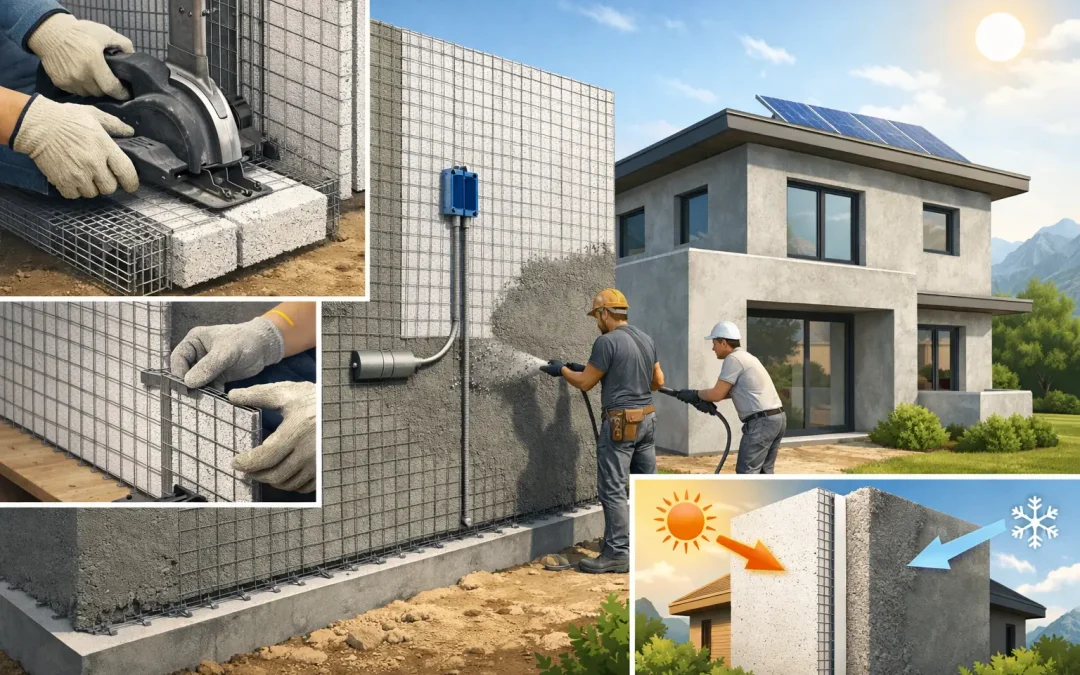
Yes. Structural concrete insulated panel construction views the exterior wall as a single structural/thermal assembly. Most SCIP panels feature a continuous EPS insulating core; a galvanized steel wire mesh; and a high-strength concrete mortar skin on both sides. As such, SCIP wall systems provide insulation, structural capability, and durability.
What benefits do continuous EPS cores offer?
Continuously EPS cores minimize thermal breaks that are inherent in framed wall assemblies, thereby conserving energy. The EPS core in the SCIP panels allows for easier creation of contiguous wall planes. Once the concrete mortar skins are applied to both sides of the panel, the assembly attains mass and enclosure integrity, thus stabilizing interior temperature levels in many climatic conditions.
What simplifies the process for installing SCIP systems?
Installing SCIP systems simplifies the steps required to install framing, sheathing, insulation, and finishes for a wall assembly. Simplifying these steps is significant given labor costs and limitations in finding skilled workers. Installing faster will positively affect project economics.
When evaluating SCIP systems versus wood-framing exterior walls, what are the differences?
Wood framing is popular due to familiarity among crews, existing supply chain infrastructure, and low initial cost assumptions relative to alternatives. However, higher-performing/higher-risk applications are creating decision-making challenges related to compromises associated with wood-framing wall assemblies.
Compared to wood-framing wall assemblies, SCIP wall assemblies improve thermal continuity. Thermal continuity is improved since the SIP panel integrates insulation into its structural center rather than relying upon separate cavity-insulation layers with individual air-leakage barriers in wood-framing wall assemblies. Moreover, thermal continuity is improved due to the lack of studs/gaps/drafty detailing typical of wood-framing wall assemblies.
How does SCIP compare to wood-framing in fire-prone areas?
The difference was demonstrated clearly following the recent Los Angeles Palisades fires. National media attention has highlighted SCIP as an alternative to combustible wall constructions. The difference is more pronounced in terms of combustibility.
Beyond the immediate threat posed by fires, why are SCIP panels preferred over wood-framing for hurricane and seismic environments?
SCIWall panels are preferred for hurricane and seismic environments because they provide structural response capabilities superior to those offered by wood-framing in resisting wind forces and lateral loads.
This is no longer a niche discussion for companies interested in using combustible wall constructions after experiencing fire-related losses or seeking enhanced hurricane/seismic performance. This decision-making challenge impacts cost, risk, and building lifespan.
Does Structural Panels GCT provide more than literature brochures for professionals requiring information on SCIP panels?
Yes. Structural Panels GCT supplies a full range of SCIP wall panels, application equipment, and technical assistance for SCIP wall systems.
Why is it important that exterior walls perform at more than a basic level?
Exterior walls are no longer merely envelopes; they also serve as part of an overall energy strategy, structural performance, and risk management strategy for building owners/developers.