
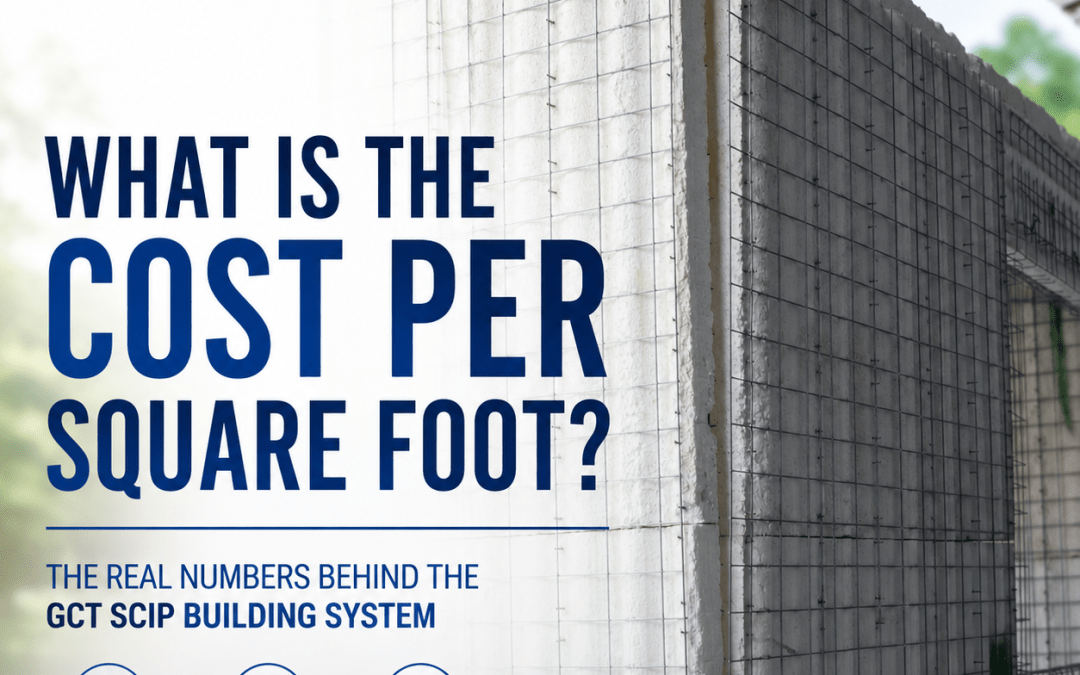
“What is the cost per square foot?” This is the very first question every architect, general contractor, and property owner asks when evaluating the GCT SCIP Building System. It is an understandable starting point. However, in advanced building technology, a simple square-foot price for materials alone tells only a fraction of the story.
To build an accurate budget, you must evaluate the installed cost versus the material cost. Because SCIP alters how a building is assembled, it fundamentally restructures your entire line-item budget—slashing costs in sectors like heavy equipment and labor, while reallocating those savings into premium, high-performance structural materials. Let’s break down the real numbers.
Breaking Down the Cost Components of a SCIP Project
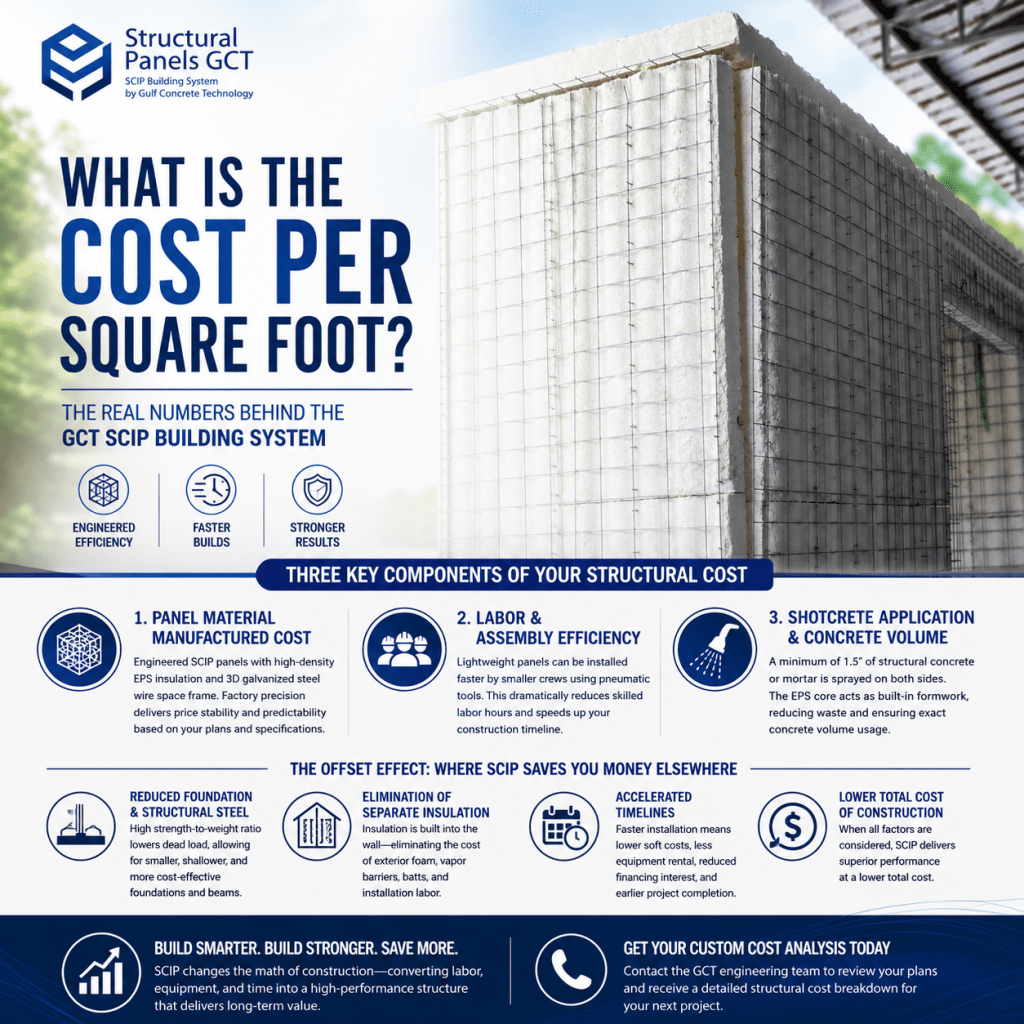
When estimating a building utilizing GCT Structural Concrete Insulated Panels, the total structural cost per square foot is divided into three primary categories:
1. The GCT Panel Material Manufactured Cost
This encompasses the engineered panels themselves—the precision-cut high-density EPS insulation core and the industrial-grade, 3D galvanized steel wire space frame. This cost is highly predictable and determined directly by your architectural blueprints, wall thicknesses, and structural engineering specifications. Unlike volatile timber or fluctuating local block pricing, factory-manufactured SCIP components provide price stability during your bidding phase.
2. Labor and Assembly Efficiency
This is where the financial scale tips heavily in favor of SCIP. Standard structural walls require skilled masonry crews working at a slow pace. SCIP panels are exceptionally lightweight (a standard wall panel weighs a fraction of an equivalent block layout) and can be easily placed by a smaller crew. The labor cost per square foot drops because panels are rapidly erected, aligned, and tied together using basic pneumatic wire tools.
3. Shotcrete Application and Concrete Volume
The final structural step involves spraying a minimum of 1.5 inches (or more as specified by engineering) of structural concrete or high-strength mortar onto both faces of the panels. This phase includes the cost of the concrete mix itself and the specialized shotcrete pump equipment rental. Because the EPS core acts as a perfect built-in formwork, you use exactly the amount of concrete required by the structural calculations, avoiding the unpredictable blowout wastes typical of traditional formwork.
The Offset Effect: Where SCIP Saves You Money Elsewhere
To understand the true cost per square foot, you must subtract the immediate savings SCIP creates in other traditional budget categories:
Foundation and Structural Steel Reductions: Because a SCIP wall utilizes a high-strength composite sandwich action, it provides incredible load-bearing capacity at a significantly lower dead weight than solid concrete or packed CMU walls. This lower mass allows structural engineers to optimize and reduce the size, depth, and cost of foundations, footings, and structural grade beams.
Elimination of Separate Insulation Subcontracts: With SCIP, your insulation is already inside the wall. You completely eliminate the material and labor cost of purchasing and installing secondary vapor barriers, fiberglass batts, or rigid exterior foam boards.
Accelerated Construction Timelines: Shortening a commercial build schedule by weeks or months directly slashes your soft costs—including jobsite security, supervisor salaries, less wood framing materials, equipment rentals, and financing interest.
Real-World Pricing Expectations
While precise costs vary based on regional labor rates, structural engineering requirements, and overall project scale, commercial and high-end residential SCIP structural wall assemblies generally track competitively with high-quality, fully insulated concrete structures.
However, when you calculate the total net cost—factoring in the speed of dry-in, downsized HVAC equipment requirements, and minimized interior/exterior finishing preparation—SCIP consistently delivers a lower total cost of construction alongside a drastically superior structural product.
Conclusion & Action Step
Evaluating a building system solely by its raw material cost is a costly oversight. The GCT SCIP system alters the math of your build, converting labor hours and machinery rental expenses into structural concrete and insulation that stays with the property forever.
Ready to see the real numbers for your specific build? Stop guessing your square foot expenses. Request a direct material estimate from GCT today by uploading your project dimensions to our estimating team in our Request A Quote area or send us a message via WhatsApp at 228-343-2475
.