
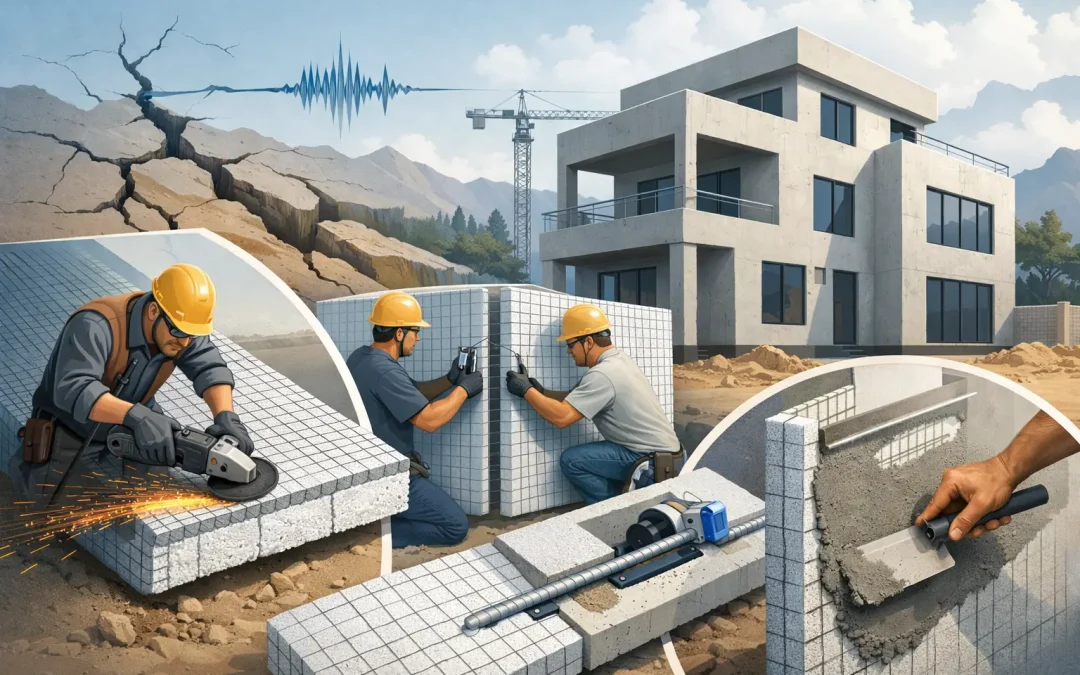
After the Palisades fires, many builders and owners started asking a harder question than how fast they could rebuild. They asked what they should rebuild with. In seismic regions, that question quickly leads to earthquake-resistant building panels and whether conventional wood framing still makes sense for projects expected to face more than one type of hazard over their service life—and whether SCIP earthquake-resistant structural panels offer a more resilient alternative.
That shift matters because seismic design is no longer a narrow engineering conversation. Developers are weighing insurance exposure, architects are balancing code compliance with envelope performance, and contractors are pressured to control labor while delivering stronger buildings. In that environment, panelized structural systems like SCIPs are getting serious attention—not as a niche alternative, but as a practical way to build for resilience.
What earthquake-resistant building panels actually need to do
A panel is not earthquake resistant because of marketing language. It performs in a seismic event because the complete assembly manages forces in a predictable way. That includes stiffness, ductility, load transfer, diaphragm action, connection detailing, and continuity from roof to wall to foundation.
This phase is where many material comparisons go off track. The panel alone is only part of the story. Engineers need to understand how the finished SCIP assembly behaves once installed, reinforced, and integrated with the structure. Contractors need a system that they can build consistently. Owners need confidence that the installed product matches the tested design—not just the brochure.
For seismic applications, the best-performing systems combine structural continuity with lower dead load where possible, while still providing enough rigidity and energy dissipation to resist lateral movement. It depends on the building type, height, occupancy, and site conditions, but the core requirement stays the same: the system must carry loads reliably through the whole structure during cyclical movement.
Why SCIP panels are a serious seismic option
SCIP, or Structural Concrete Insulated Panel, answers that requirement with a system-based approach. A typical SCIP panel uses galvanized steel wire mesh on both faces of an EPS insulating core, then receives high-strength concrete mortar applied to create a reinforced composite assembly. Once completed, the wall acts as more than cladding or insulation. It becomes part of the building’s structural shell.
Engineers need to understand how the finished SCIP assembly behaves once installed, reinforced, and integrated with the structure. Contractors need a system that can be built consistently. Owners need confidence that the installed product matches the tested design—not just the brochure
Wood-frame construction can be effective when engineered and detailed correctly, but it has trade-offs. It relies heavily on many individual members, connectors, sheathings, and field tolerances. In a seismic event, weak points often show up at the joints, openings, and transitions between trades. With SCIP, the assembly is more integrated. There are still critical details to get right, especially at openings, corners, floor connections, and roof diaphragms, but the system reduces dependence on a large number of separate structural parts.
That is one reason SCIP has gained attention in disaster-prone regions, including recent coverage tied to post-fire rebuilding discussions in Los Angeles and long-standing seismic performance in markets such as Venezuela. For teams looking beyond business-as-usual framing, the appeal is straightforward: one system can address earthquake resistance, fire performance, wind resistance, and thermal efficiency simultaneously.
Seismic performance is only valuable if it fits the jobsite
A lot of structurally capable systems lose momentum during estimating or installation. They are too slow, too specialized, or too dependent on labor that is difficult to source consistently. That is where panelized systems need to prove more than engineering strength.
SCIP panels are practical because they can reduce framing complexity and accelerate enclosure. Lighter panel components are easier to handle before shotcrete or plaster application, and crews can erect wall and roof assemblies quickly when the workflow is organized correctly. For contractors dealing with labor shortages or tight schedules, that matters just as much as structural testing.
There is a trade-off, though. SCIP is not a drop-in substitute for every crew using conventional framing methods. Field teams need training on staging, bracing, mesh continuity, utility chases, mortar application, and sequencing. The learning curve is real. But once crews understand the system, the labor model often becomes more efficient because fewer separate materials and steps are required to achieve structure, insulation, and substrate in one assembly.
Earthquake-resistant building panels vs wood framing
For professionals reevaluating material choices after recent disasters, the comparison often centers on risk concentration. Wood framing can be cost-competitive upfront, familiar to crews, and widely accepted in the market. But in seismic and fire-prone regions, familiar does not always mean optimal.
SCIP panels change the conversation because they address multiple exposures at once. The concrete‑encased assembly is noncombustible, and the structural shell is fundamentally different from a combustible stud‑cavity approach. This does not eliminate all design considerations, but it materially improves the building’s risk profile.
From an operating standpoint, the EPS core also contributes strong thermal performance. That means owners are not choosing resilience at the expense of energy efficiency. In hot climates, coastal markets, and mixed-hazard regions, that combination can improve lifecycle economics in a way traditional structural comparisons often miss.
The best choice still depends on project goals. A low-rise project with abundant framing labor and minimal hazard exposure may not justify a system change. But for institutional buildings, multifamily developments, schools, industrial facilities, and housing in seismic or high-risk zones, the value case for SCIP strengthens quickly.
What specifiers should look for before choosing a panel system
If a project team is evaluating earthquake-resistant building panels, the first step is not price per panel. it is system validation. Engineers and architects should look for code alignment, evaluation documentation, structural testing, and clear load path details for the intended application.
That includes questions about allowable spans, reinforcement requirements, connection details, diaphragm integration, opening reinforcement, and foundation anchorage. It also means reviewing how the system performs under combined demands. Seismic exposure rarely arrives alone. In many U.S. and Caribbean markets, the same building may need to address wind, moisture, heat, and fire exposure as part of one design decision.
Contractors should ask equally practical questions. How are the panels delivered? What equipment is needed for mortar mixing and application? How are electrical and mechanical runs accommodated? What does the installation sequence look like for walls, floors, and roofs? A system that performs well on paper but slows the site will face resistance from the field.
This is where complete system providers have an advantage. When the panel manufacturer also supports equipment, training, technical guidance, and project-specific quoting, the risk of field misalignment drops. Structural Panels GCT operates in that lane by treating SCIP as a full building system rather than a commodity panel.
Why this matters now
Construction teams are not rethinking material systems in a vacuum. They are responding to visible failures, rising insurance pressure, labor volatility, and stricter expectations around durability. Recent wildfire losses in California have pushed more owners to question combustible assemblies. Seismic events in the Caribbean and Latin America continue to remind the market that structural strength is not theoretical.
That creates a narrow window where decision-makers are open to replacing default materials with better-performing systems. Not because alternative construction is trendy, but because the risk math is changing. When one assembly can provide structural capacity, insulation, speed, and hazard resistance, it deserves serious specification review.
For engineers, that means evaluating the whole structural behavior, not just the panel brochure. For contractors, it means considering the labor and schedule advantages of building with fewer separate systems. For developers and owners, it means looking past initial material cost to the larger question of long-term performance under real-world stress.
The projects that age best in seismic regions are usually the ones that designers built with fewer assumptions and more discipline. If you are planning in a high-risk market, the smarter move is not to ask whether a panel system is different from wood framing. It is to ask whether your current assembly is doing enough for the level of risk your project will actually face.