
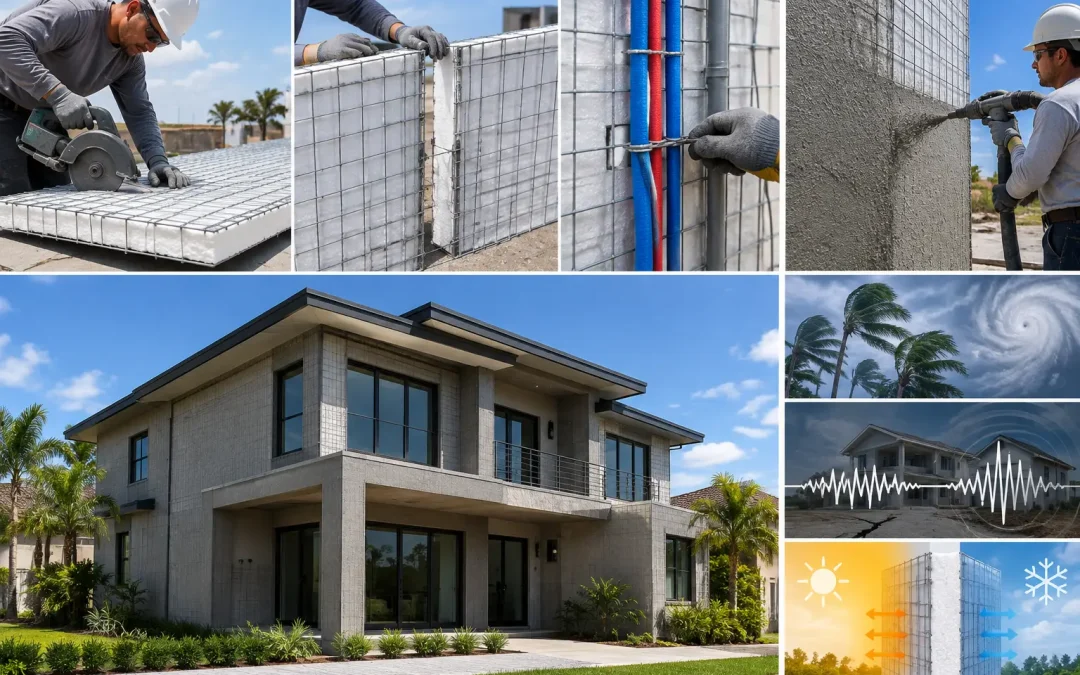
A SCIP wall is not complete when the panel is set. Its galvanized steel wire mesh, EPS insulating core, connections, openings, and concrete mortar coating must work as one engineered assembly. That makes the shotcrete versus hand applied mortar decision more than a finishing preference. It affects production rate, labor planning, coating consistency, jobsite control, and the ability to deliver the structural performance shown in the project documents.
For builders moving away from vulnerable wood-frame assemblies, the question is especially timely. The rebuilding conversation after the Los Angeles Palisades fires, along with seismic events affecting Venezuela and other high-risk regions, has put durable, noncombustible structural systems under sharper scrutiny. SCIP construction provides a practical path to hurricane-resistant, earthquake-resistant, energy-efficient buildings, but only when the mortar application method matches the design and the crew’s capabilities.
Shotcrete versus hand applied mortar for SCIP
Shotcrete is mortar or concrete pneumatically conveyed through a hose and projected at velocity onto the panel surface. In SCIP work, crews commonly use a wet-mix process: the mortar is mixed before it enters the pump, delivered through a hose, and applied by a trained nozzleman. Dry-mix shotcrete is also used in some applications, but it requires precise water control at the nozzle and a crew experienced with that process.
Hand applied mortar is mixed on site and placed manually with trowels, hawks, or similar tools. It can be built up in lifts, screeded to plane, and finished by hand. This approach is familiar to plaster and masonry crews and requires less specialized application equipment at the start of a project.
Neither method is automatically right for every scope. The correct choice depends on wall area, required mortar thickness, schedule, crew training, access, local equipment availability, and the structural engineer’s specifications. What should not change is the required outcome: complete mesh embedment, a continuous specified coating, proper consolidation, controlled curing, and verified thickness on both faces of the panel where the system requires it.
Where shotcrete creates a construction advantage
On a full home, multifamily development, hotel, school, warehouse, or industrial project, shotcrete usually provides the stronger production case. A properly sized mixer and pump can keep mortar moving continuously while the nozzleman coats broad wall and roof surfaces. The crew spends less time carrying buckets, repositioning small batches, and waiting for manual placement to catch up.
That speed matters because SCIP panels can be erected quickly. If mortar application becomes the bottleneck, the schedule advantage of panelized construction is lost. Shotcrete helps the coating phase keep pace with installation, allowing contractors to close in larger sections of the building efficiently.
Velocity is another major benefit. When applied correctly, shotcrete consolidates material against and through the wire mesh, reducing voids and helping create intimate contact with the panel assembly. The nozzleman can also build the specified thickness in controlled passes rather than relying on repeated hand placement over a large area.
Consistency is not automatic, however. Shotcrete quality depends heavily on nozzle distance, angle, travel speed, air volume, mix design, pump calibration, and crew coordination. A nozzle held too far away or at a poor angle can increase rebound and create uneven buildup. Material that rebounds must not be worked back into the wall. It is waste, not structural mortar.
For that reason, productive shotcrete work starts before the pump is turned on. The contractor needs an approved mix design, material staging, clean equipment, reliable water and power, test panels when required, and a trained nozzleman. Thickness checks, surface preparation, curing procedures, and inspection hold points should be planned into the work, not treated as corrections after the fact.
Labor efficiency is more than crew size
Shotcrete can reduce labor hours per square foot, but it does not eliminate the need for skilled people. A typical operation still needs personnel for mixing, feeding material, hose management, nozzle application, thickness verification, trimming, finishing, and cleanup. The difference is that each worker supports a continuous, high-output process rather than manual placement across every square foot.
This distinction is meaningful in markets where skilled construction labor is expensive or difficult to schedule. A contractor can invest in equipment and training, then apply that capability across repeat projects. For developers building multiple units or phases, the gain is not merely faster walls. It is more predictable production and a clearer path to meeting turnover dates.
When hand applied mortar is the practical choice
Hand application remains useful on small projects, isolated additions, repairs, parapets, tight areas, and locations where moving a pump and hose is impractical. It may also be appropriate during early project phases when a contractor is developing SCIP experience, provided the crew understands the system requirements and can consistently achieve the specified thickness.
Manual placement gives finishers close control around window and door openings, embedded items, corners, service penetrations, and transitions to conventional construction. Even on shotcrete projects, hand-applied mortar is often part of the workflow for touch-up, detailed shaping, and final surface correction.
The trade-off is output. Large surfaces placed by hand require substantially more labor, more handling of material, and more opportunities for variation between workers and shifts. Crews can achieve excellent results, but the contractor must actively manage lift thickness, mesh coverage, bond between lifts, and plane. A wall that looks smooth is not necessarily a wall with uniform structural coating.
Hand application can also become a false economy. The equipment cost may be lower, but a long manual installation schedule increases labor exposure, site overhead, and the risk that weather or trade sequencing will delay the project. On a modest repair, that trade-off may be acceptable. On hundreds or thousands of square feet of SCIP wall, it often is not.
Compare the methods by the project, not by habit
The most reliable selection process starts with quantities and performance requirements. If the project has large, repetitive wall areas and a demanding schedule, shotcrete is generally the better fit. It supports fast installation, efficient mesh embedment, and more consistent coverage when operated by a qualified crew.
If the scope is small, highly detailed, remote, or limited by equipment access, hand applied mortar may be the more economical method. It can also provide needed control in areas that a hose cannot reach comfortably. The key is to price the full labor requirement honestly, rather than comparing only the cost of a pump to the cost of a mixer.
A hybrid approach is common and often smart. Use shotcrete for primary wall, floor, or roof panel surfaces, then use hand application for corners, openings, penetrations, localized corrections, and finish work. This combines production efficiency with detail control without forcing either method into work it does poorly.
Structural performance depends on execution
A SCIP assembly derives its strength from the composite action of the steel mesh and cementitious skins around the insulating core. The mortar coating is therefore a structural component, not decorative plaster. Its thickness, compressive properties, reinforcement coverage, continuity at joints, and connection detailing must follow the approved engineering and applicable code requirements.
Shotcrete does not make a wall stronger simply because it is sprayed. Hand-applied mortar does not make it weaker simply because it is troweled. The installed assembly performs when the specified materials are mixed correctly, placed correctly, cured correctly, and inspected correctly. Any claim of superior performance has to be tied back to the project’s tested system, engineering, and quality-control program.
This is particularly critical in hurricane, fire, and seismic zones. Owners and insurers are evaluating more than first cost after major disasters. They want assemblies that can support documented design requirements, reduce energy demand, and avoid the combustible framing vulnerabilities that can drive catastrophic losses. SCIP panels offer that performance-focused alternative, but the field application must protect the integrity of the system.
Plan the application method before mobilization
Bring the applicator, panel supplier, general contractor, and design team into the conversation before panels arrive on site. Confirm mortar specifications, target thicknesses, access requirements, sequencing, weather protection, curing, sample areas, inspection responsibilities, and equipment capacity. For shotcrete, confirm hose routes, staging locations, cleanup procedures, and backup plans for pump downtime. For hand application, confirm crew productivity assumptions and how thickness will be monitored across broad surfaces.
Structural Panels GCT supports SCIP projects with panels, mortar mixing and application equipment, and technical guidance because the coating process cannot be separated from system performance. The strongest project teams treat it as a coordinated installation operation from the first layout line to final cure.
Choose the method that gives your crew the best control over the specified result at the pace your project requires. When that decision is made early and executed with discipline, SCIP construction can deliver the resilient, efficient building envelope owners are asking for.